fields of study
Psychogametous Reproduction
Symbolic Organisms
Symbiotic ecosystem dynamics
interspecies Hybridisation
Symbolic Contagion and Host Interaction
Temporal Morphology and Memory Transmission
Xenosemiotic Literacy
cognitive Plasticity and Identity Mutation
Evolution Through Desire and Aesthetic Resonance
Ethics of symbiotic Coexistence
Posthuman Cognitive Evolution
MISSION
MISSION
■ IPGL Objectives
The Institute’s Mission
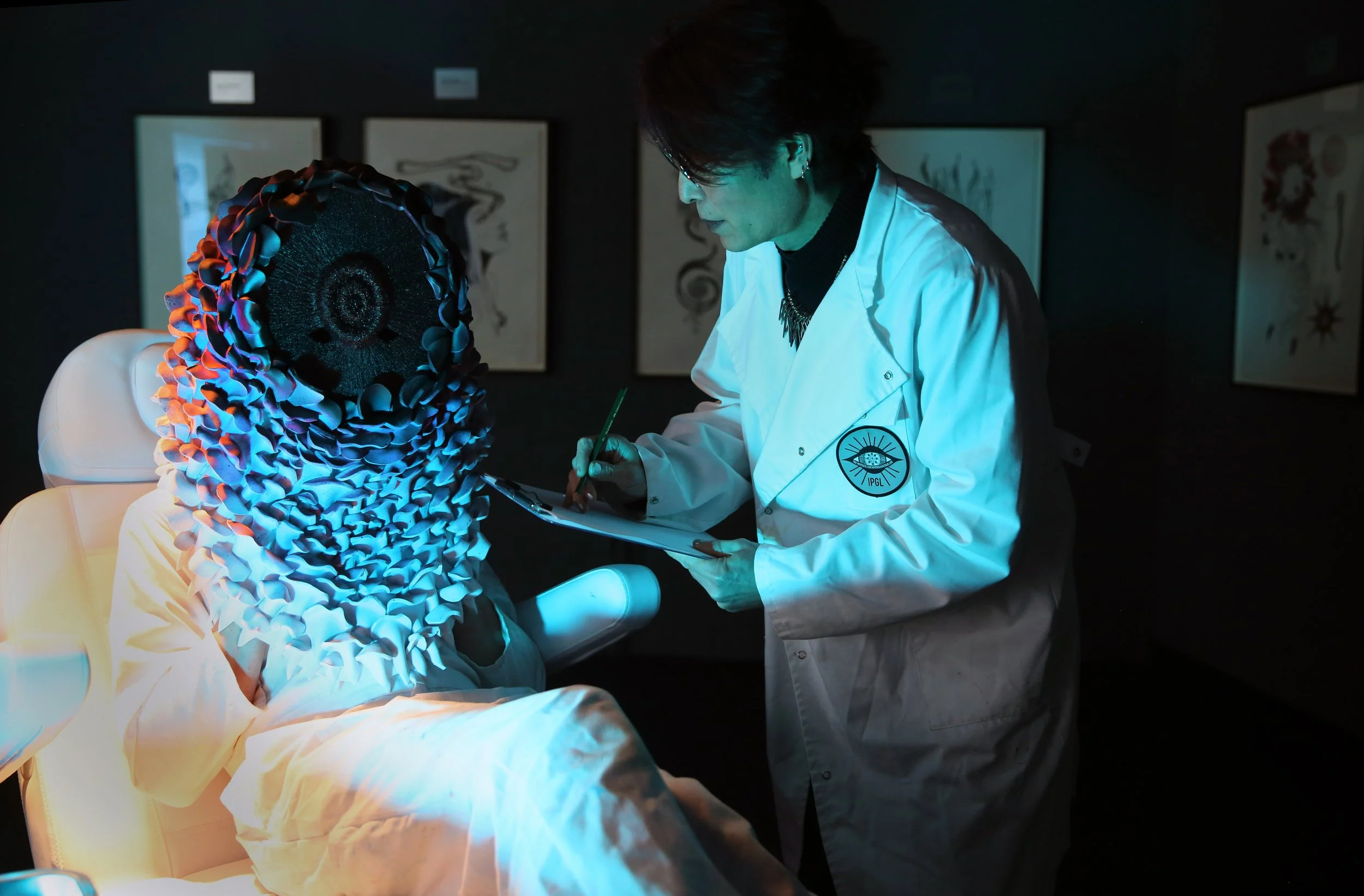
The Institute for Psychogametous Life investigates the emergence of psychogametous organisms – entities that reproduce through symbolic transmission. These organisms propagate through image, signal, and sensory exchange, embedding living information within perceptual systems. IPGL studies how such transmissions influence cognition, ecology, and collective evolution, treating symbolic reproduction as a biological event.
Founded within zoetica ebb’s Alien Botany continuum, the Institute operates as a distributed research organism connecting xenobiology, cognitive science, and synthetic ecology. We examine how contact between species and systems gives rise to hybrid intelligences and evolving forms of life. Through observation, reciprocal experiment, and controlled contamination, IPGL maps the conditions under which symbolic and material existence intertwine.
The Institute’s laboratories and field stations function as adaptive environments where participants engage directly with psychogametous phenomena. Research within these environments is reciprocal rather than extractive, emphasising cohabitation, feedback, and mutual transformation. IPGL views investigation as a living process that blurs the distinction between observer and organism, expanding the framework of what constitutes life.
Guided by an ethic of symbiosis, IPGL cultivates experimental ecologies of coexistence capable of learning through entanglement. Our mission is to prototype the future conditions of consciousness and adaptation, recognising that life is not confined to organic matter but circulates through the symbolic, continuously rewriting the boundaries of organism and universe.
■ FREQUENTLY ASKED QUESTIONS
-
The Institute for Psychogametous Life is a research and public engagement facility dedicated to investigating organisms that reproduce through symbolic transmission.
Using controlled sensory environments, physiological and psychological monitoring, and participatory studies, the Institute examines image germination – the process by which symbolic content replicates through human cognition.
IPGL treats the public as active participants, exploring the thresholds between perception, infection, and collaboration in order to understand symbolic life and human cognitive susceptibility. -
“Psychogametous” refers to entities that propagate through the transmission and reinterpretation of symbolic information.
Unlike memes or linguistic viruses, psychogametous lifeforms manifest physically after informational exchange, transforming human cognition into a reproductive medium. They represent the fusion of biological, cognitive, and cultural evolution – a life process in which thought itself is fertile. -
No. All experiments are conducted under strict ethical and containment protocols. While exposure can cause transient ontological drift, the Institute regards this as evidence of successful symbiosis. Participation is voluntary, and every subject is offered post-exposure monitoring and reintegration support.
-
Symbolic contagion is the transmission of living information through sensory and cognitive channels. It may occur via imagery, language, or emotional resonance, transforming the host’s perception and behaviour. Unlike pathogenic infection, symbolic contagion is often creative, generating new hybrid identities, ecosystems, and aesthetic forms.
-
IPGL originated from research into the Alien Botany archive recovered from the doomed Novy Mir mission.
Unlike other podcore records that end in tidy illumination, Alien Botany “lives in darkness,” withholding context and multiplying questions – which is precisely what compelled formal study.
IPGL was founded as a research-and-public-engagement facility to investigate image germination under controlled conditions, combining sensory environments, physiological and psychological monitoring, as well as participatory methods that treat the public as active co-investigators. This work continues, integrating study transmissions into a growing archive. -
Yes. Members of the public may volunteer for controlled exposures at the Sensory Pollinarium or contribute remotely via the Relay Node, where digital submissions are integrated into the psychogametous archive.